



How to Get Rid of Fire, Argentine and Desert Ants: Ant Control Phoenix AZ
Arizona homeowners deal with ants year-round, but not all ants are the same. Fire ants, Argentine ants, and desert ant species differ in behavior and nesting and require different treatment strategies. Ant control Phoenix professionals say misidentifying your ant species is the most common reason treatments fail. Handling an infestation without professional help almost always leads to recurring problems. Correct identification followed by professional intervention is the only reliable path to permanent results.
This guide explains how to identify Arizona’s three most problematic ant species, what attracts them to your property, why professional treatment is essential, and what to expect from a licensed Phoenix general pest control provider at every step.
Identifying Fire, Argentine, and Desert Ants in Arizona
Correct identification is the foundation of every effective ant control program. Treatment that works on Argentine ants may be ineffective against fire ants, and desert species require a different approach. Knowing the species is the first step any qualified ant pest control AZ technician takes before recommending a treatment plan.
Fire Ants (Solenopsis xyloni and Related Species)
Fire ants are reddish-brown to red with a darker abdomen, ranging from one-eighth to one-quarter inch long. They build large, irregular mounds in open sunny areas like lawns, parks, schoolyards, and landscaped beds. These mounds can reach up to 18 inches in diameter. When disturbed, they swarm aggressively and deliver repeated painful stings. Multiple ants attack at once, releasing venom that causes burning, raised welts, and in rare cases, serious allergic reactions.
Fire ant colonies nest deep in the ground, so surface-level treatments almost never work without professional-grade products and techniques. The queen and brood—the eggs, larvae, and pupae—are protected far below the surface and out of reach of consumer products. Disturbing a fire ant mound without targeted professional treatment causes the colony to scatter and reestablish nearby, worsening the problem.
Key identifying characteristics of fire ants:
- Reddish-brown body with a darker, almost black abdomen
- Irregular, dome-shaped mounds with no visible opening at the top
- Extremely aggressive response to any nest disturbance
- Workers vary in size within the same colony (polymorphic, meaning different-sized workers serve different roles)
- Active foraging along defined trails toward food and water sources
Argentine Ants (Linepithema humile)
Argentine ants are among the most difficult invasive species to control in the United States, and Arizona’s irrigated urban landscape makes them especially persistent in the Phoenix Metro. Small (about 2 to 3 mm), light to dark brown, and releasing a faint musty odor when crushed, they travel in wide, visible trails from outdoor colonies into kitchens, bathrooms, pantries, and wall voids quickly.
Unlike most ant species, Argentine ants form massive supercolonies—networks of connected nests sharing workers and queens, functioning as one large colony rather than several separate ones. A single supercolony can stretch across an entire neighborhood block. For perspective, a documented Argentine ant supercolony in California stretched over 560 miles of coastline, with connected colonies sharing workers and queens across vast distances. In Phoenix, one supercolony can span multiple neighboring properties. This is why treating one yard without coordinated professional intervention rarely produces lasting results.
Consumer-grade broadcast sprays only kill foraging workers—a small fraction of the colony—while the queen and brood remain underground. Worse, spraying causes ants to scatter and form new satellite colonies, expanding the infestation. Professional treatment using non-repellent chemistries and colony-targeted baiting programs is the only approach that consistently collapses Argentine ant supercolonies.
Key identifying characteristics of Argentine ants:
- Small, uniformly sized workers (monomorphic, meaning all workers are the same size)
- Light to dark brown coloring with no stinger and no bite risk to humans
- Travel in wide, dense trails rather than single-file lines
- Found near moist soil, irrigated landscaping, and water sources
- Active year-round in Arizona due to mild winters
Desert Ants (Forelius and Harvester Species)
Desert ant species native to Arizona, including Forelius and harvester ants, are part of the local ecosystem but can become nuisances around Phoenix homes. Forelius ants are small, bright orange, and strongly attracted to sugary foods. They are harmless but should never be disturbed without professional treatment because doing so releases a pheromone—a chemical signal that recruits more colony members—drawing more ants to the location.
Harvester ants are larger, ranging from one-quarter to one-half inch, and build distinctive flat, cleared mound nests surrounded by bare soil. They collect seeds as their primary food, creating large bare patches in lawns and landscaping. Both species sting, and harvester ant stings are notably painful. Unlike Argentine ant supercolonies, desert species maintain smaller, localized nests that respond well to targeted professional mound treatments and scheduled perimeter applications.
Key identifying characteristics of desert ants:
- Forelius ants are small and bright orange, attracted to sweet foods and commonly found near pool decks and outdoor kitchens.
- Harvester ants are larger with distinctive flat, cleared mounds and no central opening.
- Both species sting and can be painful, particularly for children and pets.
- Desert species nests are localized, making professional mound treatment highly effective.
⚡ Know Your Ant Before Anyone Treats It.
Fire ants nest deep underground and require colony-targeted professional treatments. Argentine ants form massive supercolonies that scatter and reestablish if treated incorrectly. Desert species need different approaches again. A licensed technician identifies your species first — every time.
Arizona Ant Activity by Season
Because Arizona stays warm most of the year, ants remain active year-round instead of going dormant in winter. Knowing when each species is most active helps homeowners schedule preventive treatments with their pest control provider instead of reacting after infestations develop.
Spring (March to May) Fire ant colonies become highly active as soil temperatures warm. Worker foraging intensifies and mound construction accelerates. This is the ideal time for professional broadcast granular bait application before summer heat reduces surface foraging. Argentine ants begin moving indoors as outdoor temperatures climb, following moisture trails into kitchens and bathrooms.
Summer (June to August) Surface foraging by fire ants slows during peak afternoon heat, but colony activity continues underground. Argentine ants thrive in irrigated soil and stay aggressively active throughout this period. Professional perimeter treatments and exclusion work now provide critical protection before monsoon season begins.
Monsoon Season (July to September) Heavy rains flood underground nests, forcing fire ants and desert species to relocate rapidly toward dry elevated shelter, often into homes. Winged reproductive ants take mating flights triggered by monsoon moisture, spreading new colonies across neighborhoods. This is the highest-risk period for new infestations, and when prompt professional ant pest control AZ response has the greatest impact.
Fall and Winter (October to February) Argentine ants move closer to heated structures as outdoor temperatures drop. Professional perimeter retreatment and entry point sealing during this time prevent the spring activity surge. Fire ants are slow at the surface, but colonies remain alive underground and will resurge aggressively with spring warmth.
⚡ Treat Before the Season Peaks, Not After. The most effective ant control is preventive
Spring professional bait applications, pre-monsoon perimeter treatments, and fall retreatments consistently outperform reactive treatments applied after infestations are established.
What Attracts Ants to Arizona Homes
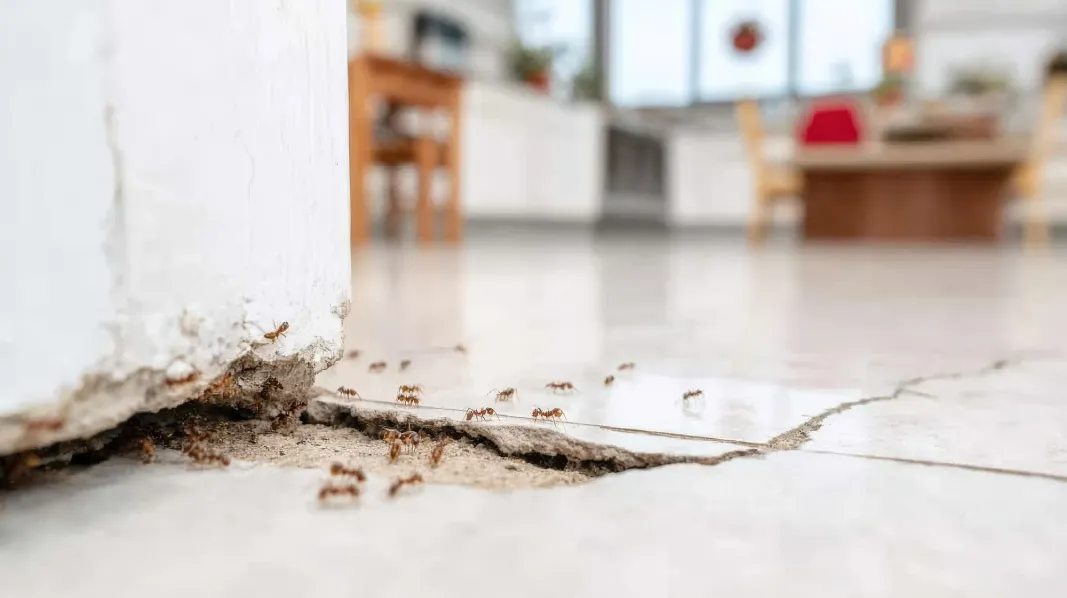
Understanding what draws ants indoors helps homeowners work better with their pest control provider to eliminate conditions that sustain infestations between visits. Arizona’s extreme heat drives ants to seek cooler, moister environments, making your home a target during the hottest months and after monsoon flooding displaces outdoor nests.
A common Phoenix scenario shows how easily this happens: a homeowner receives repeated professional treatments with diminishing results. The source is a drip irrigation emitter leaking against the foundation, creating the moist soil environment Argentine ants need to sustain their supercolony near the home’s entry points. A thorough professional inspection identifies and fixes conditions as part of a complete treatment plan.
Common ant attractants in Phoenix homes include:
- Food sources include open pantry items, fruit on counters, pet food bowls left outdoors, grease residue near stovetops, and crumbs in hard-to-clean areas. A dog bowl left outside overnight becomes an immediate target for desert and fire ant colonies.
- Moisture from leaking pipes, condensation under sinks, dripping HVAC drain lines, and standing water in plant trays or pool decks creates the environment Argentine ants specifically require.
- Landscaping contact, such as mulch, dense shrubs, tree branches, and potted plants touching exterior walls, provides shelter and a direct entry bridge into the home.
- Entry points like gaps around utility penetrations, foundation cracks, poorly sealed door sweeps, and deteriorating weatherstripping give ants access regardless of outdoor treatment.
- Irrigation systems in Arizona create moist soil conditions against your foundation, building an ideal nesting habitat for Argentine ant supercolonies year-round.
- Monsoon season flooding from heavy summer rains floods underground nests, forcing fire ants and desert species to relocate rapidly toward the dry elevated shelter of your home.
⚡ Conditions Matter as Much as Chemistry
Professional treatment works best when the conditions sustaining the infestation are identified and corrected alongside the chemical program. A qualified technician addresses both products and the environment that keeps drawing ants back.
What Professional Ant Control Actually Delivers
This is where the difference between a recurring ant problem and a resolved one becomes clear. Professional ant control Phoenix providers have access to chemistries, equipment, and treatment protocols that consumer products cannot replicate. They apply them with species-specific knowledge that makes each application count.
Colony-Targeted Baiting Programs
Slow-acting insecticidal baits used by licensed technicians exploit the colony’s foraging behavior. Worker ants carry bait back to the colony and feed it to the queen and brood, eliminating the reproductive core rather than just surface foragers. Professional baits contain active ingredients like spinosad (a naturally derived insecticide) or indoxacarb (a slow-acting compound ants carry and feed throughout the colony) in formulations and concentrations unavailable in consumer products.
For fire ants, professionally applied broadcast granular bait delivered around mound perimeters and along foraging trails carries the active ingredient deep into the colony. For Argentine ants, precision gel bait placement along active trails and at key entry points targets the supercolony over time. A fire ant mound treated with professional-grade spinosad bait may show reduced activity within five days and full colony collapse within two to three weeks. Seeing increased ant activity near bait placements in the first week is normal — it confirms the bait is being actively recruited and carried back to the queen.
Non-Repellent Residual Perimeter Treatments
Professional-grade perimeter applications use non-repellent residual products, meaning ants cannot detect the chemical, so they walk through the treated zone and carry it back to the colony rather than avoiding it. Common professional active ingredients include bifenthrin, fipronil, and imidacloprid. These are applied in a band extending two to three feet up the exterior wall and two to three feet outward along the ground surface, covering all foundation cracks, expansion joints, and entry points.
Unlike repellent consumer sprays that ants detect and route around, non-repellent residual treatments work silently and continuously between scheduled service visits.
Physical Exclusion and Entry Point Sealing
A complete professional Phoenix general pest control program addresses the physical pathways ants use to enter the home, not just the populations present at the time of treatment. Technicians identify and seal gaps around utility penetrations, foundation cracks, deteriorating door sweeps, and landscaping contact points that sustain reinfestation between visits.
Integrated Pest Management (IPM)
IPM, using multiple control methods together rather than relying on a single chemical treatment, is the standard of care for persistent ant infestations in Arizona. A professional IPM program for ants combines species identification, targeted baiting, non-repellent perimeter applications, exclusion work, moisture management recommendations, and follow-up visits to assess colony collapse and retreat any remaining activity. This coordinated approach separates a program that permanently resolves an infestation from one that temporarily reduces visible ant numbers.
⚡ Professional Treatment Reaches Where Consumer Products Cannot
Colony-targeted baiting, non-repellent chemistries, and IPM protocols eliminate the queen and brood — the source of the infestation — not just the workers visible on the surface. This is the difference between temporary relief and lasting results.
What to Expect From a Professional Ant Control Visit
Knowing what a quality professional service visit looks like helps homeowners evaluate providers and set realistic expectations for the treatment process.
A thorough professional ant pest control AZ visit should include:
- Species identification is confirmed before any product is selected or applied.
- Property inspection covering interior foraging trails, exterior mound locations, landscaping conditions, moisture sources, and potential entry points
- Customized treatment plan specifying which products will be used, where they will be applied, and why – matched to the identified species and infestation scope
- Bait placement in protected locations along active foraging trails, near entry points, and around identified colony sites
- Perimeter application using non-repellent residual chemistry around the full foundation exterior
- Entry point documentation with recommendations for sealing and sanitation improvements that support the chemical program
- Follow-up scheduling is necessary because a single visit rarely achieves permanent colony elimination for fire ants or Argentine ant supercolonies.
- Clear communication about what homeowners should expect to see in the days following treatment, including normal increases in ant activity near bait stations
A reputable provider will also address pet and child safety directly — explaining re-entry times after any spray application, confirming bait station placement is out of reach of pets and children, and answering questions about product selection without pressure.
⚡ One Visit Is Rarely Enough
Frequently Asked Questions About Professional Ant Control in Arizona
Yes, when applied by a licensed technician using approved products. Always inform your provider about pets before the visit. Most treatments require keeping pets away from treated surfaces for 30–60 minutes while the application dries.
Conclusion
Getting rid of fire, Argentine, and desert ants in Arizona requires correct species identification, professional-grade colony-targeted baiting, non-repellent perimeter applications, and physical exclusion work, all coordinated through a structured Integrated Pest Management program that addresses the root population rather than just visible surface activity. Ant control Phoenix homeowners can rely on comes down to targeting the queen and brood, sealing every entry point, and working with a licensed professional who understands Arizona’s unique ant species, seasonal pressures, and the specific conditions that sustain infestations in the desert climate. The most cost-effective approach is proactive professional management before colonies become established infestations.
Family First Pest Control
Arizona's Professional Ant Control Specialists
At Family First Pest Control, we understand how quickly ant infestations escalate in Arizona’s climate, and we are equipped to respond with professional-grade colony-targeted treatments, non-repellent perimeter applications, and Integrated Pest Management strategies that deliver lasting results where consumer products fall short. Whether you are dealing with aggressive fire ant mounds in your backyard, Argentine ant trails invading your kitchen, or desert species nesting along your foundation, our licensed Phoenix team identifies the species, targets the colony, and protects your family and your home with a treatment program built specifically for Arizona’s year-round ant pressure.